
Quick Verdict
Spocket is a better starting point when choosing products from its supplier marketplace is the main task. AutoDS is better suited to merchants evaluating broader importing, price and stock monitoring, and order-management automation across multiple supplier workflows. Neither eliminates the need to check suppliers, delivery costs and the platform fees attached to the features you need.
Affiliate disclosure: This article contains affiliate links. If you sign up through one of them, we may earn a commission at no additional cost to you.
Compare Spocket plans and current offers
The most useful way to approach Spocket vs AutoDS is to decide what slows your business down. If you cannot find reliable products with suitable shipping, you have a sourcing problem. If you already know what to sell but spend too much time importing, updating and processing products, you have an automation problem.
Spocket and AutoDS overlap, but they prioritize these problems differently.
AutoDS versus Spocket: the key differences
| Category | Spocket | AutoDS |
|---|---|---|
| Primary approach | Supplier marketplace and store connection | Automation platform with connected supplier sources |
| Product research | Browse its catalog and supplier listings | Research and importing across available suppliers |
| Inventory and price management | Connected product and stock-related tools | Monitoring is a central part of the feature set |
| Order workflow | Retailer must process and pay supplier orders as required | Automation depends on supported supplier and selected service |
| Store management | Multiple stores with per-store subscription conditions | Multiple-store features on eligible plans |
| Pricing | Published Starter, Professional, Empire and Unicorn | Feature and product-limit tiers; offer and region may vary |
| Best fit | Sourcing decisions and supplier comparison | Repeatable catalog and order automation tasks |
Product sourcing: one supplier network versus multiple channels
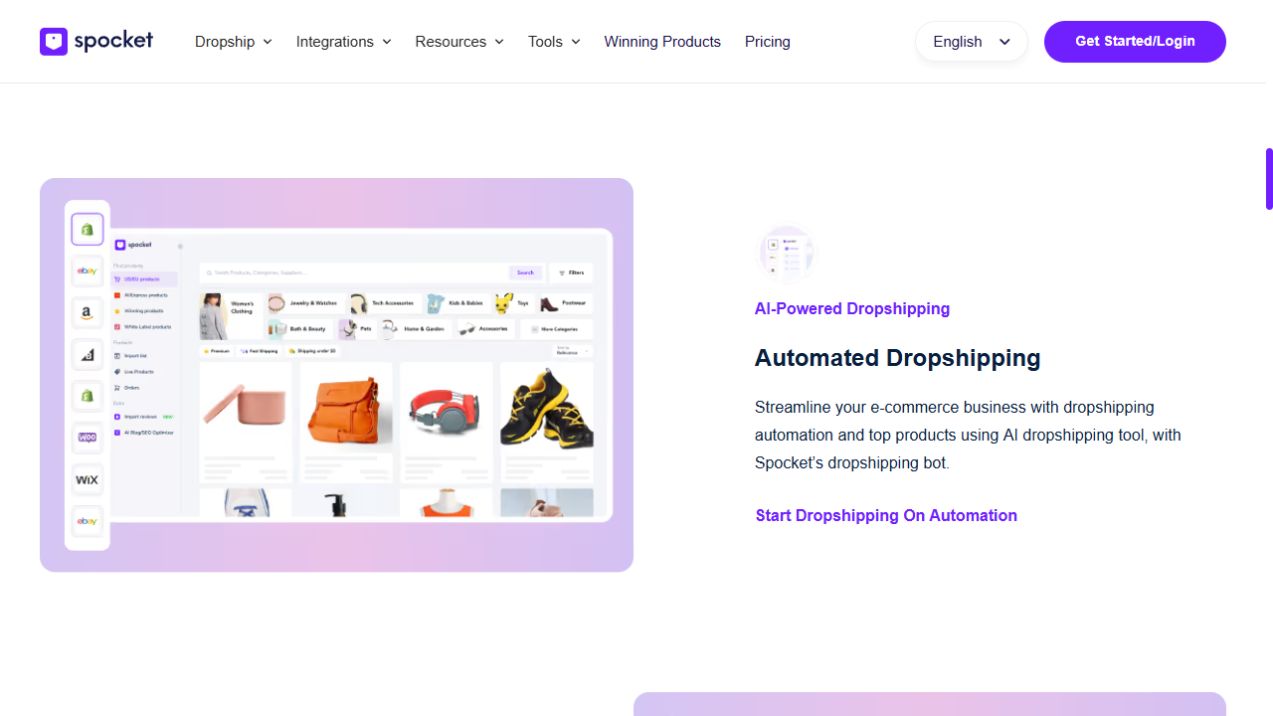
Spocket gives you a marketplace of products, many from suppliers in the US and EU. This is attractive if your store cares about regional origin and a connected catalog. Your evaluation starts at the listing: Does this supplier ship to my target country? What is the landed cost? Will it meet my return expectations?
AutoDS emphasizes tools that can import products and work with multiple supplier sources. That breadth offers flexibility for merchants who already know how to vet products, but it can add complexity. Each supplier has its own lead times, shipping rules and possible account requirements.
A sourcing tool with fewer but better-suited listings may beat a larger product feed. A broad automation tool can beat a smaller one when you manage many active products. Your actual operating model determines which advantage matters.
Does AutoDS automate orders more than Spocket?
AutoDS markets automatic order handling and tracking capabilities on supported suppliers and plans, along with options such as a fulfillment service. This can reduce repetitive work, but you still need to understand what the software does, which accounts it uses, and how exceptions and failed orders are handled.
Spocket connects sourcing and order management to the store, but its help instructions specifically warn that a supplier does not ship until the retailer's order has been checked out and paid. This is an important process difference when comparing “automation” on a plan page.
Ask both services how an order moves from your Shopify checkout to the supplier, who pays the supplier, how stock errors are handled, and when a tracking number appears. A single unchecked automated rule can be more costly than a few manual steps on a low-volume store.
Price and stock monitoring
Monitoring is one of the reasons merchants evaluate AutoDS. When prices change or inventory runs out at a supplier, a connected system can help keep store listings more accurate. That can protect you from selling out-of-stock variants or unexpectedly unprofitable products.
Spocket also describes price and stock-related monitoring features, but it is important to compare the actual behavior supported for the supplier and store you use. Verify how frequently data updates, whether variants are mapped correctly, and which changes are applied to your store without manual review.
Do not assume automation guarantees error-free data. Check a small sample of real products against the supplier listing regularly.
Spocket vs AutoDS pricing and trials
Spocket's published monthly plans start at $39.99 Starter and rise through $59.99 Professional, $99.99 Empire, and $299.99 Unicorn. Paid monthly tiers advertise an eligible seven-day trial, with annual billing options on selected tiers.
AutoDS has a current pricing page organized around importing, product limits, and higher automation tiers. The displayed offer can vary by configuration, region and plan selection. Its page advertises a paid short trial on certain offers, so check the amount and renewal information shown for your account.
More importantly, calculate your total operating cost, including subscription, any order-fulfillment service charges, product price, shipping and external payment processing. A $20 platform difference each month matters less than an unseen $3 extra per order once you sell a few hundred units.
For Spocket-specific tiers, see our Spocket pricing guide and current coupon offers.
Which tool makes more sense for Shopify?
Spocket's Shopify workflow is straightforward: connect the store, add products to an import list, edit and push them, then process orders through the supplier workflow. It can be a good fit for a merchant who manages a narrow, curated catalog with a few trusted suppliers.
AutoDS can be attractive when your Shopify workload involves importing from several supplier sources, bulk editing, repricing, or monitoring a larger set of products. The price of that flexibility is the need to learn more configuration and track which automation features apply to which supplier.
For a merchant who has only three products and has not yet made a sale, sophisticated automation should not outrank product-market fit and shipping reliability.
Example: a 30-product store versus a 1,000-product operation
A specialty store with 30 carefully selected home accessories might only need stable supplier listings, a straightforward Shopify connection and sensible order handling. Spocket Professional could support that catalog size, assuming suitable supplier inventory exists.
A store managing hundreds of variations across several supplier networks may value automatic price and stock monitoring, bulk management, and exception handling more highly. AutoDS deserves closer examination in that scenario. Still, verify product limits and fees under the specific subscription rather than buying the largest plan immediately.
What neither platform solves for you
Neither platform can guarantee profit, strong advertising performance, zero returns, or consistently fast shipping across all products. Both require the merchant to publish correct descriptions and set realistic delivery expectations. You also remain responsible for your customers when a package is delayed or an item is damaged.
Start with a small set of items and compare the actual order flow end to end. If you are new to the business, the Spocket dropshipping guide explains the operational foundations that matter before automation.
Frequently asked questions
Is AutoDS better than Spocket?
AutoDS can be better for complex automation and supplier workflows. Spocket can be better for a retailer who likes its supplier marketplace and requires a straightforward connected sourcing process.
Does Spocket automatically update product prices?
Spocket describes monitoring capabilities, but verify how they work for the selected integration and plan. Do not assume every storefront update is always automatic.
Can AutoDS work with several suppliers?
Yes. Multi-supplier sourcing and import workflows are part of its product positioning, though the specific supported suppliers and features should be checked by plan.
Is AutoDS free?
Its current public page advertises paid plans and a short trial offer. Check the exact cost and terms at signup; do not assume unlimited free use.
Should I switch if I already use Spocket?
Switch only if another platform solves a concrete problem at a justifiable total cost. Plan for current orders, product listings, refunds and subscription cancellation before changing your workflow.
The Bottom Line
Use Spocket when selecting the right suppliers is your main challenge, and consider AutoDS when repeated catalog and order operations are consuming meaningful time. Verify the same supplier, store and order conditions before treating a feature checklist as evidence of a better business outcome.