
Quick Verdict
Choose Spocket when its supplier marketplace and US or European product sourcing are the main attraction. Choose Zendrop when fulfillment workflow, branding options and product sourcing services are the priorities. Neither platform guarantees faster shipping on every item. Compare the specific product, warehouse, destination, plan and order process before committing.
Affiliate disclosure: This article contains affiliate links. If you sign up through one of them, we may earn a commission at no additional cost to you.
Compare Spocket plans and current offers
A Spocket vs Zendrop comparison is really a question about what your store needs after it finds a product. Both services can help you source dropshipping items, but their positioning, plans, and approach to fulfillment are different enough that a merchant should not choose on price alone.
Spocket versus Zendrop at a glance
| Decision point | Spocket | Zendrop |
|---|---|---|
| Main positioning | Supplier marketplace with connected store sourcing | Product sourcing and fulfillment-oriented platform |
| Supplier geography | Prominent US and EU options, plus other regions | US products and other supplier options by plan and listing |
| Shopify | Supported | Supported |
| Branding | Branded invoicing on eligible plans | Branding options and print-on-demand capabilities on selected plans |
| Pricing structure | Paid tiers plus Basic access and eligible seven-day monthly trial | Free limited access and various paid arrangements |
| Shipping | Supplier and destination dependent | Product and fulfillment option dependent |
| Best fit | Merchants shopping for a particular source and connected catalog | Merchants evaluating fulfillment and brand experience |
These differences describe the platforms, not a guarantee that every product in one service beats every product in the other. Delivery speed, quality and cost depend on the listing you choose.
Product sourcing: regional selection versus fulfillment focus
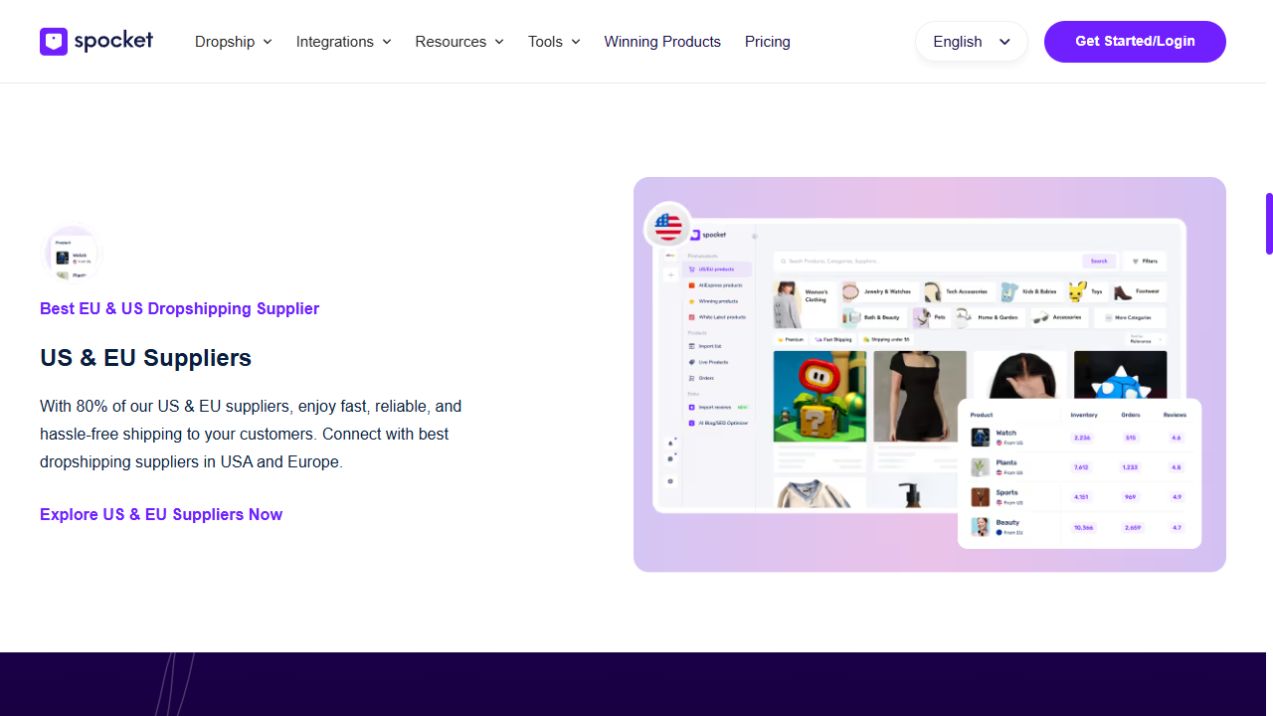
Spocket emphasizes finding products from independent suppliers, including many in the US and Europe. That can be a useful starting point for a store whose customers are primarily in those regions. The decision still requires you to check origin, delivery destination and supplier return policy for every item.
Zendrop also provides access to a product catalog and promotes fulfillment services. Its platform offers US product options and requests for products as part of its broader selling proposition. The important question is which service can provide the exact category you sell at a landed cost your customers can support.
If you sell small home-organization accessories to customers in Germany, for example, compare the actual product options shipped to Germany. A US-focused catalog is not inherently useful in that scenario. If you sell a high-volume product to US buyers and need special packaging, evaluate the sourcing and branding terms instead.
Zendrop versus Spocket for shipping times
It is tempting to declare one company the winner for fast shipping, but that would be misleading. Spocket displays supplier processing and transit estimates that differ by destination. Zendrop fulfillment also depends on the item, inventory location and delivery route available to your plan.
For a fair test, pick the same type of product, choose the same delivery ZIP code, and compare shipping charges plus processing days plus transit days. When possible, order samples through the actual platform. A promise such as “fast US shipping” is not enough to price your customer-facing delivery policy.
For the steps involved in checking Spocket listing dates, see our Spocket shipping guide.
Branding: which service helps you build a store identity?
Spocket advertises branded invoicing and supplier messaging on eligible plans. That is a useful improvement over an obviously generic supplier document, but do not mistake it for full private labeling or custom manufactured products. Available packaging options depend on the supplier and the service actually purchased.
Zendrop markets more fulfillment-led branding possibilities, and its published plan information includes custom branding and print-on-demand features on selected tiers. That may be attractive to stores trying to create a memorable post-purchase experience. Always confirm the particular plan and product eligibility before advertising branded packaging to your own customers.
If branding is your main differentiator, ask each provider what is printed, who inserts materials, what the setup costs, and what order volume is needed. The details matter more than a feature checkmark.
Spocket and Zendrop pricing compared
Spocket's public monthly pricing currently starts at $39.99 for Starter, followed by $59.99 Professional, $99.99 Empire, and $299.99 Unicorn. Professional, Empire and Unicorn also have posted annual options with reduced monthly equivalents. Its public page describes a seven-day trial on eligible monthly paid plans.
Zendrop's pricing depends on the product tier and sometimes how the account was created. Its plan page lists free limited access and paid options, while Zendrop's plan guide distinguishes Shopify-billed subscriptions from legacy and usage-based arrangements. Treat the live checkout for your store as the controlling price.
A cheaper subscription does not necessarily mean lower order costs. Include supplier price, freight, branding add-ons, order handling and refunds in your total. The first month is only one line in the profit calculation.
Shopify workflow and day-to-day operations
Spocket has a documented Shopify app and a direct Shopify connection flow. You select products, add them to an import list, edit listings, and push them to the store. When an order arrives, you must make sure the supplier order is processed and paid through the relevant workflow.
With Zendrop, check how order fulfillment is triggered, how your subscription affects available automation and branding tools, and how tracking is shared with Shopify. The right choice depends on whether you want to spend more time selecting suppliers or less time managing repeated fulfillment steps.
For detailed Spocket setup, see our Shopify integration tutorial.
Which is better for beginners?
Spocket can be a strong starting point if you already have a target niche and want to compare supplier listings by location, shipping and product price. Start with a narrow product selection so you can validate quality and demand before expanding.
Zendrop may fit someone who cares about fulfillment operations, wants access to coaching or education on eligible tiers, or plans to build a branded customer experience around a particular product. Those options should be valued only if you will actually use them.
Neither app is a substitute for product-market fit. A beginner who has not selected a niche should avoid a large annual commitment on either platform.
How to make the decision with one real product
Choose a product type and a target destination. Record the supplier cost, shipping price, delivery estimate, sample quality, storefront integration requirements, return terms, and plan costs for both platforms. Then try the available workflow and look for confusing steps or unexplained fees.
An illustrative example: if two nearly identical products can sell for $40 and one costs $15 delivered while the other costs $22 delivered, the $7 difference matters more than small differences in the monthly subscription for a store shipping hundreds of orders. If the cheaper product has unreliable fulfillment, though, refunds may eliminate the saving.
Frequently asked questions
Is Zendrop cheaper than Spocket?
It depends on the plan, billing route, order volume and services you need. Zendrop has limited free access and several paid arrangements; Spocket has Basic browsing plus paid tiers. Compare the complete checkout and product costs.
Does Spocket have US suppliers?
Yes. US and European suppliers are part of its sourcing proposition, but check each product's actual shipping location and available destinations.
Does Zendrop offer branded products?
Zendrop advertises custom branding and print-on-demand options on selected plans. Confirm eligibility, pricing and product availability before choosing it for that reason.
Can I switch from Spocket to Zendrop?
You can evaluate another supplier platform, but plan how you will handle live orders, product listings, customer returns and subscription cancellation before disconnecting your existing workflow.
Which is better for Shopify dropshipping?
Both are relevant to Shopify. Spocket may suit supplier-led product selection; Zendrop may suit a fulfillment-first process. The best answer depends on the products and operational requirements of your store.
The Bottom Line
Spocket and Zendrop solve overlapping but different problems. Choose Spocket when the suppliers and listings you find there fit your market. Choose Zendrop if its fulfillment or branding services solve a more important operational need. Test one product with the same destination and cost assumptions before making a year-long decision.