
Quick Verdict
Spocket and Syncee both help stores source products from suppliers, but Syncee places more emphasis on its wholesale and dropshipping marketplace, retailer-to-brand relationships, and supplier approval workflows. Spocket is attractive when its curated listings and connected store process suit your niche. At current published monthly prices, the platforms have several similarly priced tiers, so supplier fit and product limits matter more than a small app-fee difference.
Affiliate disclosure: This article contains affiliate links. If you sign up through one of them, we may earn a commission at no additional cost to you.
Compare Spocket plans and current offers
A Spocket vs Syncee comparison matters because both products pitch themselves to ecommerce sellers who want to source inventory without buying boxes of stock in advance. That overlap makes them easy to confuse. Yet the way they structure supplier relationships, product access and subscriptions can change the experience of running your store.
Spocket emphasizes its dropshipping supplier marketplace and connected store workflows. Syncee describes itself as a marketplace that connects retailers with independent brands and wholesalers, including businesses that want to move from dropshipping orders into wholesale purchasing. Both have suppliers in multiple locations, but the product you choose matters more than the broad geographic claims.
Spocket versus Syncee: side-by-side comparison
| Category | Spocket | Syncee |
|---|---|---|
| Main purpose | Dropshipping sourcing and store integration | Dropshipping and wholesale supplier marketplace |
| Free access | Basic browsing access, paid selling plans | Free browsing plan with limited supplier information |
| Entry monthly paid plan | Starter: $39.99, up to 25 unique products | Basic: $39.99, up to 100 imports from one supplier |
| Mid-tier monthly plan | Professional: $59.99, up to 250 unique products | Pro: $59.99, up to 250 products and unlimited suppliers |
| Higher monthly plan | Empire: $99.99, up to 10,000 unique products | Business: $99.99, up to 10,000 products |
| Free trial | Seven days on eligible monthly paid plans | Three days on monthly paid plans |
| Supplier relationships | Supplier selection and communication within platform | Some suppliers require retailer approval; wholesale options |
| Shipping | Specific supplier and destination | Specific supplier and destination |
Prices and eligibility above are based on the providers' public US-dollar monthly plans. Check the live checkout and individual supplier requirements before subscribing.
How the two marketplaces actually differ
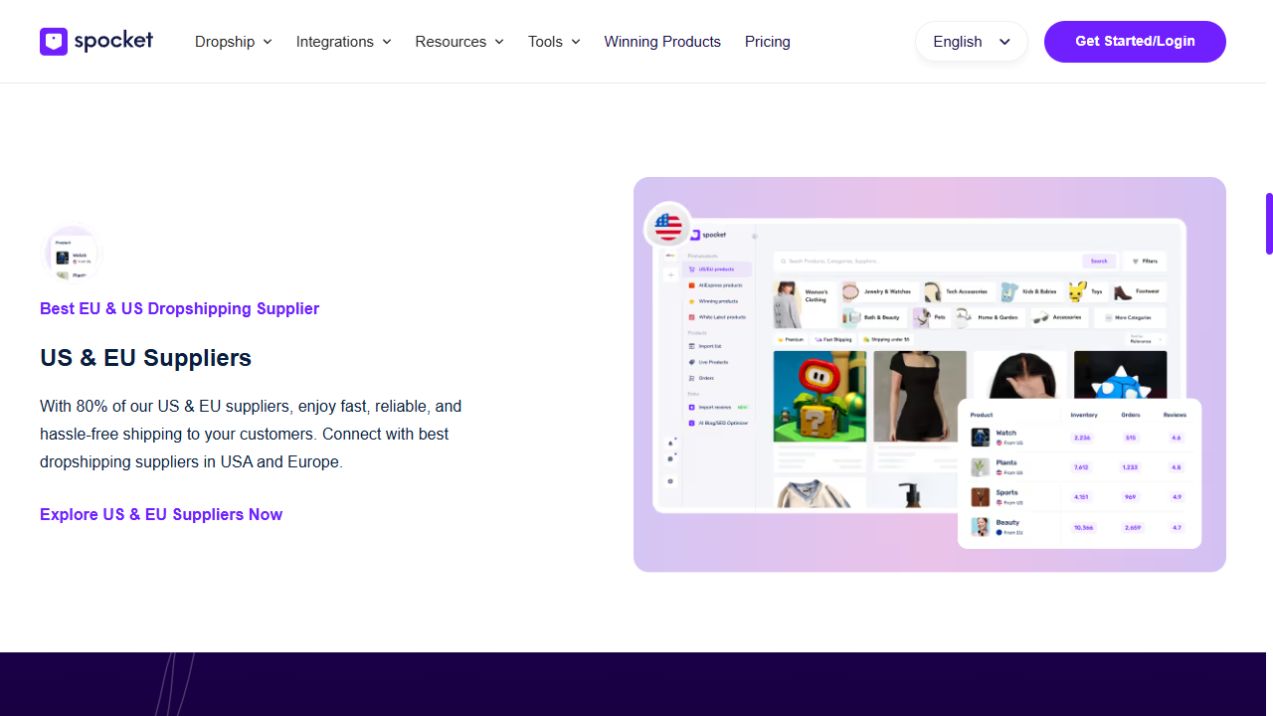
A Spocket product search is designed to help a dropshipping retailer find goods, inspect a supplier listing and connect the product to an ecommerce store. Its marketing emphasizes access to US and European suppliers, though the catalog also includes global products and AliExpress capabilities. You should still inspect origin and delivery details for every order.
Syncee describes a marketplace where retailers can find products from brands and wholesalers that want to sell through partner stores. Some suppliers want to approve the retailer before the retailer can access or sell certain items. That creates an additional relationship step, but may be useful if you want to build a catalog around smaller independent brands.
Neither approach makes it safe to upload a hundred unfamiliar products without sampling. Supplier willingness, item consistency and regional shipping matter more than catalog size.
Spocket and Syncee pricing: what $39.99 actually buys
This is the biggest practical difference for merchants starting with a small catalog. Spocket's Starter plan is currently $39.99/month for 25 unique products. Its Professional plan is $59.99/month for 250 unique products, while Empire is $99.99/month for 10,000.
Syncee's published pricing lists Basic at $39.99/month for 100 products from one supplier, Pro at $59.99/month for 250 products with unlimited suppliers, and Business at $99.99/month for 10,000 products. Its detailed plan guide also describes a higher Plus tier for merchants managing much larger catalogs.
A 100-product limit sounds better than 25 products at an identical price, but there is a catch in the comparison: Syncee Basic limits you to one supplier. If that supplier does not have enough products in your niche, your practical selection may be much smaller than the headline capacity suggests. Spocket Starter's 25-product ceiling may be acceptable for a focused specialty store, but restrictive if you sell a wide range.
| Example store plan | What to check first |
|---|---|
| Single-supplier niche boutique | Syncee Basic supplier limit and catalog fit |
| Curated 15-item test store | Spocket Starter product range and shipping |
| 150-item multi-brand store | Spocket Professional vs Syncee Pro |
| Large catalog business | Empire vs Business and actual automation workload |
These are purchasing scenarios, not promises that all features are identical at matching price points.
Can you use Spocket and Syncee for free?
Both offer a form of free access, but neither should be represented as providing every paid selling feature at no charge. Syncee's Free plan supports marketplace exploration, favorites and limited supplier information. Its paid monthly plans list a three-day trial.
Spocket has Basic marketplace access and advertises a seven-day trial for eligible monthly paid plans. Annual plans require upfront payment and should not be mistaken for a trial. Spocket also has separate subscription requirements for each connected store that needs paid functionality.
If you want to compare suppliers before spending money, open both free views. But if you need to publish products and manage a live business, confirm which plan and supplier approvals are required first.
View Spocket monthly plans and current offers
Our dedicated Spocket free trial guide explains how to test Spocket without accidentally committing to annual billing.
Syncee supplier approvals versus Spocket supplier screening
Spocket documents supplier standards for companies seeking to list goods through the platform. Those standards are helpful context, but a retail merchant must still evaluate sample quality, shipping costs, and the return policy of the seller chosen.
Syncee may present suppliers that ask for approval or direct engagement with the retailer. That is not necessarily a downside. A supplier that wants to review a store first may be looking for a particular retail positioning or brand fit. The inconvenience is that you cannot always assume instant access to every appealing catalog.
For an established boutique, a supplier approval process may be worth it to source products aligned with its customers. A beginner wanting to publish a first test product this afternoon may prefer a more straightforward import route.
The smart question is not how many suppliers appear in the database. It is how many suppliers will work with your store at attractive delivered margins.
Which has better shipping for US and EU customers?
Both platforms can surface regional suppliers, but you need to check the exact ship-from point and destination. Spocket product listings provide their own processing and shipping information. Syncee suppliers handle their own shipments and set terms that differ by brand.
Imagine your customers are mostly in the UK. One supplier ships the relevant product from the UK; another ships it from mainland Europe; a third requires international delivery. The best choice depends on transit, customs considerations, product price and service reliability, not on which marketplace you searched.
Build a product comparison sheet with shipping cost, expected delivery days, supplier minimum conditions, return address and sample order quality. That will tell you more than any average shipping figure.
Shopify, Wix and product synchronization
Spocket supports integrations with Shopify, Wix, WooCommerce and several other storefront systems. Its documented workflow involves finding an item, editing it in the import list and pushing it to a connected store. Product monitoring and order-management tools depend on the connected platform and subscription.
Syncee also works with several ecommerce platforms, including Shopify, and describes synchronization for product data, orders and tracking. For merchants who already have a particular ecommerce stack, the actual app integration and supplier access should be checked together.
Ask a practical question: how many products will you maintain, how often will prices or stock change, and who will notice and fix a broken listing? No software makes an inaccurate product description harmless.
Order fulfillment and supplier communication
On Spocket, customer orders need to go through the relevant Spocket order and supplier payment process. Spocket's help documentation makes clear that orders must be processed and paid before suppliers can ship them. That is especially important for stores still learning when cash leaves their account.
Syncee explains that retailers purchase ordered products through its marketplace, and suppliers fulfill those orders. Payment may use supported methods such as cards or PayPal, while supplier currency can vary. Check taxes, invoicing and refund terms because platform subscription price is only a small part of order economics.
If you have to choose between two similar products, test supplier communication. Do they answer questions about sizing, packaging and dispatch clearly? A responsive supplier can save more than a promotional subscription price.
Which is better for your store?
Choose Spocket when its listings are better suited to your target market, you want its specific integration workflow, and a relatively small paid catalog covers your initial needs. It is a good candidate for a narrow online niche built around thoroughly checked products.
Choose Syncee when independent brand and wholesaler relationships are central to your catalog, you might expand into wholesale buying, or its product limits and supplier approval options align with how your store sources merchandise.
Compare both side by side when your products are easily available through either marketplace. Judge the business on the landed cost per order, quality of the sample, time to fulfill, returns, and the service needed to keep listings current.
Frequently asked questions
Is Syncee cheaper than Spocket?
Several corresponding monthly prices are the same: $39.99, $59.99 and $99.99. The product limits, supplier restrictions and features differ, so compare what is included rather than the dollar amount alone.
Does Syncee have a free plan?
Yes. Its Free plan is intended for browsing and initial marketplace research with limited access. Selling workflows generally require a paid plan.
Does Spocket offer more free trial time than Syncee?
Their published paid monthly trial periods differ: Spocket lists seven days for eligible plans, while Syncee lists three days. Check trial terms during checkout.
Is Syncee better for wholesale sourcing?
Syncee explicitly promotes relationships that can expand from dropshipping into wholesale. Evaluate the supplier's actual prices, quantities, approvals and terms before buying inventory.
Can I use both platforms on one Shopify store?
Multiple sourcing tools may be possible, but check each app's Shopify behavior, product syncing, app fees and order management. Avoid publishing duplicates or confusing inventory rules.
The Bottom Line
Spocket and Syncee are both credible options for supplier-based stores, but their different product and supplier limits make plan-by-plan comparison essential. Choose the actual suppliers that match your niche and delivery region. Do not let a headline catalog size or a matching monthly price make the decision for you.