
Quick Verdict
Modalyst has the lower entry barrier for merchants who want to publish a small catalog because its Hobby plan is listed at $0/month for up to 25 products, but it charges a 5% transaction fee on the retail value of orders. Spocket starts at $39.99/month for its paid Starter plan and advertises a 0% platform transaction fee. Compare order volume and product fit before deciding: a free subscription is not the same as free order processing.
Affiliate disclosure: This article contains affiliate links. If you sign up through one of them, we may earn a commission at no additional cost to you.
Compare Spocket plans and current offers
When people compare Spocket vs Modalyst, the conversation often ends too early with the words “free plan.” Modalyst offers a free Hobby tier, while Spocket advertises Basic access and paid subscription tiers for running its dropshipping workflow. The important difference is not just the monthly bill. It is how each platform charges, what you can sell, and which suppliers are useful for your niche.
Both apps help merchants put third-party products into ecommerce stores. Modalyst has a visible connection to Wix commerce and a marketplace of supplier products. Spocket promotes US and European sourcing, supplier selection and integrations with platforms including Shopify and Wix. Neither app can guarantee winning products or a certain profit margin.
Spocket vs Modalyst: key differences
| Feature | Spocket | Modalyst |
|---|---|---|
| Free entry | Basic access for initial exploration | Hobby: $0/month and up to 25 products |
| Entry paid plan | Starter: $39.99/month, up to 25 products | Start Up: $35/month, up to 250 products |
| Higher plan | Professional: $59.99/month, up to 250 products | Pro: $90/month, unlimited products |
| Platform transaction fee | Spocket public pricing advertises 0% | Modalyst help center lists 5% of retail order value |
| Trial approach | Eligible paid monthly plans show seven days | Free Hobby plan is ongoing subject to tier rules |
| Ecommerce integrations | Includes Shopify, Wix, WooCommerce and others | Offers Wix, Shopify and other supported store connections |
| Supplier offering | US and EU focus plus global sourcing | Supplier catalogs including branded and independent goods |
| Best fit | Retailers with suitable Spocket listings | Merchants prioritizing free entry or broad product counts |
The listed transaction fees do not include standard storefront payment processing, product costs, supplier shipping, or other expenses your shop may incur.
The biggest difference: Modalyst's 5% transaction fee
Modalyst's pricing help page states that Hobby, Start-Up and Pro all include a 5% transaction fee on the retail value of orders. That detail can change the economics of a shop. A $0 subscription does not mean every sale flows through without any platform charge.
Spocket's official pricing advertises a 0% platform transaction fee on its paid tiers. You still pay suppliers, shipping and the costs charged by your commerce platform and payment provider. The absence of one app-specific transaction fee is not proof of lower overall costs.
Here is a simple illustration of the app fees before products and shipping:
| Example monthly retail sales | Modalyst 5% fee | Spocket listed 0% fee |
|---|---|---|
| $500 | $25 | $0 |
| $1,000 | $50 | $0 |
| $3,000 | $150 | $0 |
| $5,000 | $250 | $0 |
Those figures assume the full sales values fall under the published fee policy. They are examples, not a promise about individual invoices. You must add the relevant subscription cost as well. Modalyst Hobby could be cheaper in a small test; at higher sales values, its order fee deserves close attention.
Which monthly subscription makes more sense?
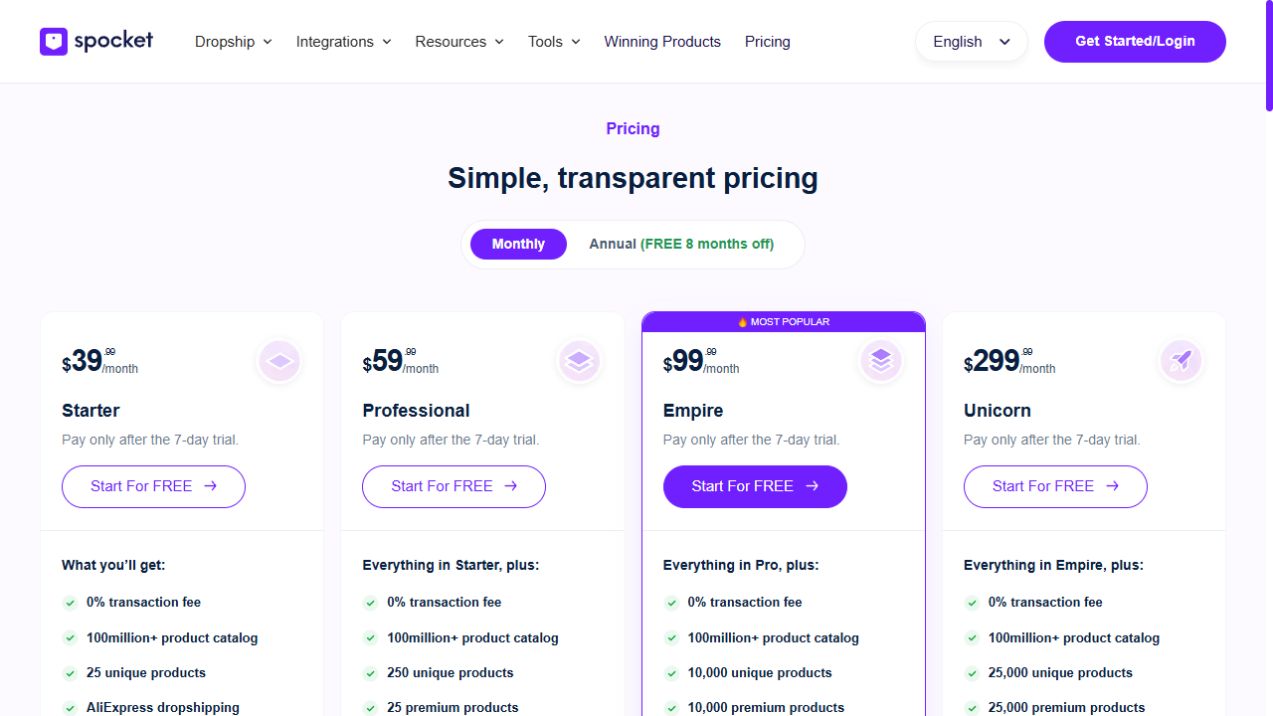
Spocket lists Starter at $39.99/month for 25 unique products, Professional at $59.99/month for 250, Empire at $99.99/month for 10,000, and Unicorn at $299.99/month for 25,000. Eligible monthly plans show a seven-day free trial, and some annual options have lower effective monthly prices.
Modalyst's pricing page lists Hobby at $0/month with a 25-product limit, Start Up at $35/month with a 250-product limit, and Pro at $90/month with unlimited products. It also advertises annual billing options for Start Up and Pro. The order transaction fee remains important when comparing those subscription prices.
For someone who wants to test just ten products, the free Modalyst Hobby tier is attractive. For a store managing 200 products, Modalyst Start Up and Spocket Professional have different fee structures and supplier offerings. If you make sales at scale, the app transaction fee can outweigh a $25 difference in the monthly subscription.
Take a look at our Spocket pricing guide for a full explanation of its limits and paid plan terms.
See the current Spocket plans and offers
Modalyst for Wix vs Spocket for Wix
Wix merchants often encounter Modalyst when looking for dropshipping catalog tools. Wix publishes documentation for connecting Modalyst to a Wix Stores website. That integration makes Modalyst a reasonable app to evaluate if your store already runs on Wix.
Spocket also documents a Wix connection. Merchants can connect a compatible Wix store, browse products, and manage imported listings using its supported integration. As with Shopify, check the exact app requirements, billing, and how orders pass from the Wix storefront to the supplier.
A good test is to import one suitable product into a non-public test listing, inspect its variant data and retail price, and check what happens when the supplier changes stock. The app with the smoother workflow for your existing store may save substantial time.
For other supported storefronts, see Spocket integrations.
Spocket vs Modalyst for Shopify sellers
Shopify merchants can evaluate both platforms as supplier sourcing apps. Spocket has an official connection process and lets you push products from an import list to a connected store. It also describes order processing, tracking and inventory or pricing monitoring through supported workflows.
Modalyst promotes one-click importing, automatic product data updates and other catalog management features in its plans. You should confirm which features apply to your store and the selected product tier, not simply assume every automation option is present in the free plan.
If you already have a Shopify app stack, consider interactions with shipping rules, inventory locations, tax settings and product variants before adding another tool. Multiple supplier apps can be manageable, but duplicate products and inconsistent stock signals create avoidable customer service problems.
Suppliers and product quality
Spocket emphasizes a supplier marketplace with US and European listings. This is useful if your buyers expect delivery from a particular region, but you must check the actual location of each item. Spocket's supplier screening standards do not replace testing samples.
Modalyst offers products from suppliers and branded categories, including the ability to access different catalogs by subscription tier. Its Pro plan describes broader marketplace access. That can help an established store with a particular merchandising style, but supplier compatibility and margin are more important than the number of available listings.
When comparing offers, choose the same product category, target country and expected retail price. Calculate product cost, shipping, app fees, packaging, delivery time and return handling for both. Then order samples before scaling.
Spocket shipping vs Modalyst shipping
Spocket shipments depend on supplier processing and shipping estimates, which may vary by destination. Modalyst suppliers likewise manage their own shipping. Neither platform has one guaranteed delivery time covering every item.
A product marked “ships from US” can still have longer processing than expected. A product shipped internationally may have a faster carrier option than a different seller's domestic route. Use estimated total delivery time and a real sample test to choose a listing.
Return policies also differ by supplier. Check the warehouse and return address before promising customers simple exchanges. Our Spocket shipping guide and refund policy guide cover those questions in detail.
When Modalyst wins and when Spocket wins
Modalyst is worth considering if: You want to start with a small free catalog, have a Wix store that connects cleanly with Modalyst, or need its particular supplier selection and are comfortable with the 5% order fee.
Spocket is worth considering if: You prefer the Spocket supplier marketplace, find products suitable for the regions you sell into, or want a paid plan where the public pricing page lists a 0% platform transaction fee.
Neither is necessarily better if: You have not checked the specific supplier catalog. A cheap plan full of unsuitable products is a bad deal. A larger plan that you do not use is also a bad deal.
To decide, model a low-sales month and a high-sales month. Include supplier charges and the fee on retail order value, not just app bills. One good supplier with reliable delivery may matter more than a plan's headline features.
Frequently asked questions
Is Modalyst free to use?
Modalyst lists a $0/month Hobby plan for up to 25 products, but its help center says a 5% transaction fee applies to retail order value. Check the full terms and what the tier allows you to publish.
Does Spocket charge a transaction fee?
Spocket's public pricing page advertises 0% platform transaction fees for its paid plans. That does not remove supplier costs, shipping or payment processing charges from your business.
Is Spocket better than Modalyst for Wix?
Both offer supported Wix workflows. Test importing, variants, inventory updates, order processing and the cost of each supplier before deciding.
Is Spocket better than Modalyst for Shopify?
The winner depends on catalog fit, supplier performance, total app and order fees, and the functionality you actually use. Both platforms are relevant to Shopify dropshipping.
Which is cheaper at 250 products?
Spocket Professional lists $59.99/month for 250 products, while Modalyst Start Up lists $35/month for 250 products plus a 5% transaction fee. Total cost depends on retail sales and supplier expenses.
The Bottom Line
Modalyst has a compelling free entry tier, but its published 5% order fee deserves attention. Spocket has higher subscription costs at entry level and advertises no platform transaction fee. Calculate your expected monthly sales volume, then compare suppliers, shipping and real order economics before choosing a paid plan.